
By Syncsine Engineering Team · Reviewed by Syncsine engineering · Updated 2026-08-26
Part 2 of 5. In Part 1 we said the tariff hike is real, and that higher common EB still becomes your maintenance. This article is the bill itself.
You do not need to love electrical jargon. You need to split a housing society electricity bill in Tamil Nadu into: the government rate versus extra lines a campus can still change. Those extras are what people search as a TNEB power factor penalty or TANGEDCO power factor surcharge. Then forward it to the secretary. You will look prepared. You will not sound like you are picking a fight.

How to read a housing society electricity bill
Ask the secretary for a photo of the common EB bill (hide account numbers before it hits WhatsApp). Your flat bill is the wrong document.
Look for four kinds of line. Names vary a little by printout. The job is the same.
1. Units (kWh) × the new rate. This is the hike everyone is talking about. TNERC sets those rates. You cannot vote them down.
2. Demand / fixed charges for the common service (how fat the connection is). Also mostly “rules,” not a WhatsApp argument.
3. Extra charges when the common supply is used inefficiently. Tamil Nadu prints this as a power factor (PF) score and a compensation line when the score is poor. You do not have to worship the name. You have to notice the rupees.
4. “Lead” or “lag” reactive figures (sometimes kVArh). If a lead number grew after rooftop solar, sunny months can look worse, not better.
On many TANGEDCO / TNPDCL HT printouts the extra is labelled power factor surcharge, PF compensation, or sits next to kVArh. Some Tamil Nadu apartment common services instead show kVAh billing — poor power factor inflates the unit itself. You are hunting rupees, not a textbook. Circle that line. Compare three months.
If the group only argues about (1), you will miss (3) and (4). Those are the lines a society can still work on. That is the whole point of a housing society electricity bill after 2024: the rate went up, and the extras got louder.

The tariff hike is line 1. The TANGEDCO surcharge is often line 3.
A housing society electricity bill hides the quiet money under a score most residents skip. Tamil Nadu tells HT common services (typical of large gated campuses): keep the average power-factor score at 0.90 or better. Below that, extra compensation is allowed on current-consumption charges. People call this a low power factor penalty on a Chennai apartment complex. The TANGEDCO power factor surcharge calculation is the table below — TNERC language, not a vendor invention.
You do not need the legal wording in your head. You need this picture:
| How bad the score is (HT) | Extra charge (rule of thumb) |
|---|---|
| A bit under 0.90, down to 0.85 | 1% of those charges for every 0.01 below 0.90 |
| 0.85 down to 0.75 | 1.5% per 0.01 below 0.90 |
| Below 0.75 | 2% per 0.01 below 0.90 |
Worked example we reuse in this series (composite 360-flat Chennai HT campus, not a named site): common load about 180 kW, score about 0.81, illustrative common bill ₹3.5 lakh.
0.81 sits in the middle band. Drop from 0.90 is 0.09. That is 9 × 1.5% = 13.5% of current-consumption charges → on the order of ₹47,000 a month, about ₹5.6 lakh a year.
If 360 flats share that extra, it is on the order of ₹130 a month per flat — only from line 3, not from the unit-rate hike. WhatsApp fights about a ₹200 maintenance bump often ignore this slice.
That is not “the government hiked the unit rate.” That is extra. If it is on your society’s bill, it is extra maintenance.
Smaller societies on certain LT three-phase categories have a different floor (often 0.85). Same idea: a poor score costs money. Ask which category the common service is.
“0.81 doesn’t look dramatic”
That sentence is how extra charges survive in a residents’ group.
A score of 1.00 would mean all the current you buy is doing useful work. 0.81 means you are hauling about 17% more current than a healthy 0.95 for the same lifts, pumps and STP. That extra current is heat in *the society’s* cables and transformer losses you already pay through maintenance. Heat is not a line item. Failed lift drives and STP motors are.
So line 3 on the bill and “our lifts keep dying” are cousins. Part 1 listed the breakdowns. This part puts rupees on the bill. Together they are why maintenance moved more than the tariff circular.
After solar: why a “green” campus can still look expensive
Rooftop solar cuts units you buy at noon. It does not automatically wipe extra charges.
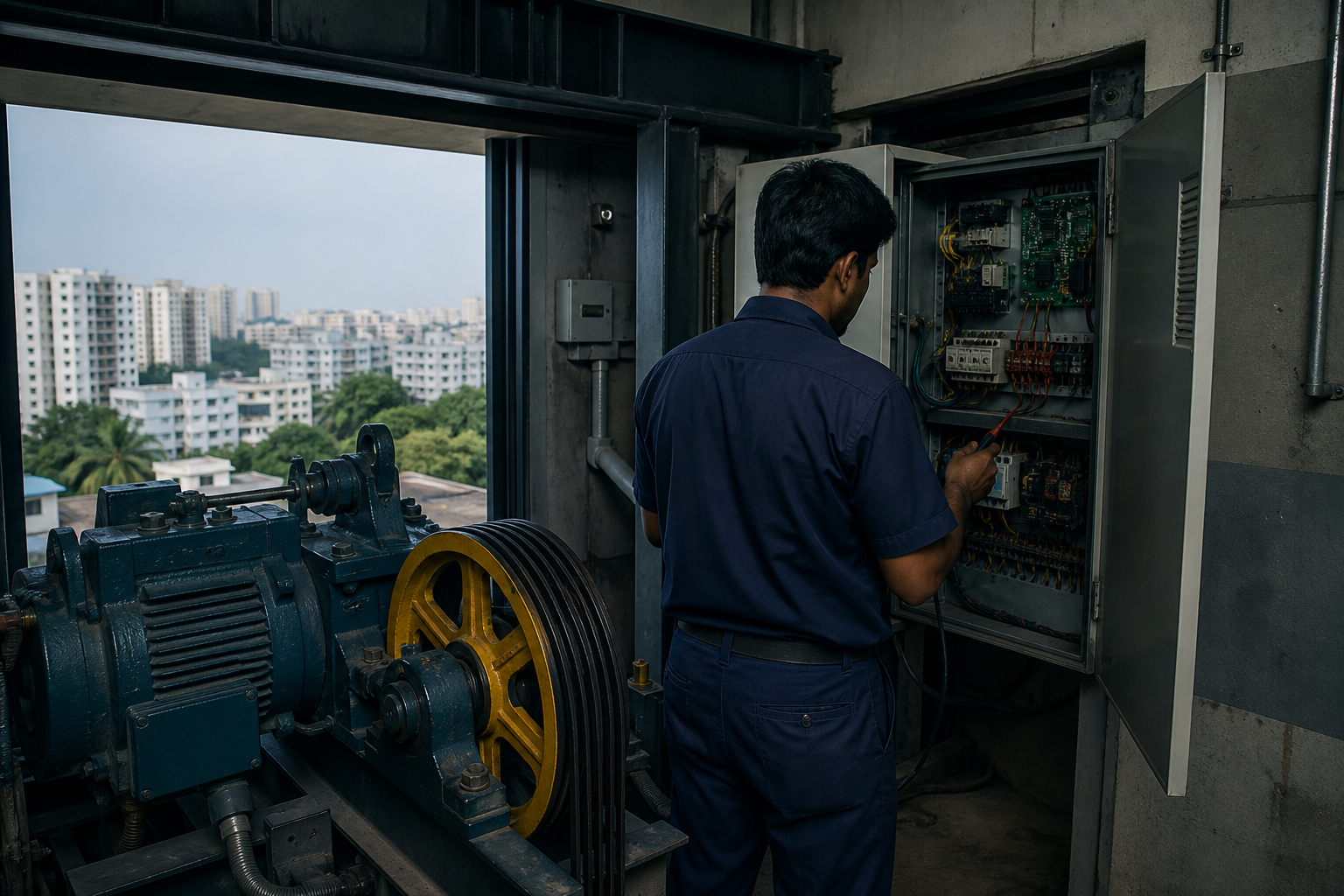
In plain language: the sun reduces what you import. The old APFC capacitor panel in the electrical room may keep pushing. On a bright day the meter can show the *wrong direction* of inefficiency (a lead register). Many DISCOM rules still treat that as a poor score. Dynamic power factor correction — often a Static Var Generator (SVG) for fluctuating solar + lift load — is a later option. First, confirm the line on three bills.
Fingerprint on a housing society electricity bill:
- Extra charges or a worse score in sunny months
- A lead figure that was near zero before solar
- Night looks “normal”; midday looks odd
If someone says “we installed solar, why is maintenance still high?” — this is one lawful answer on a housing society electricity bill. It is not an attack on solar. Solar is fine. The common bill was not retuned for solar.
Four things the hike does not explain (ask these)
Copy into WhatsApp. Attach a cropped photo of the housing society electricity bill if you have one.
1. Besides the new unit rate, is there a compensation / PF / extra line? If yes, how many rupees last month vs last year?
2. Is there a lead figure that grew after solar? Yes/no is enough.
3. Does the electrical-room panel’s display agree with the bill? If the panel says “healthy” and the bill says extra charges, someone is measuring the wrong place — or the panel is theatre.
4. How much did we spend in 12 months replacing lift drives, STP motors, or the same electrical-room parts? Bill extras plus replacements is the true “still cuttable” pile.
You now sound like a member who read the paper. The secretary gets a task list, not a pile-on.

What a society can actually save
Nobody is cancelling the TNERC rate.
What you *can* aim for:
- Knock off line 3 (and the solar-lead version of it) if the campus is sitting at ~0.81. In the example, that is on the order of ₹47,000 a month — collected from you as maintenance if it stays.
- Fewer dead motors. One lift-drive replacement can dwarf a month of extra charges.
- Stop AMC that only swaps the same swollen boxes.
Do the same maths on *your* three bills. If line 3 is small, say so in the group and move on. If it is large, that is the argument for a measured look — not for buying the first panel that appears in the electrical-room chat.
A first cut with *your* load and score (if the secretary has last month’s housing society electricity bill) is the free Power Quality Solution Sizer. Not a quotation. A way to stop arguing in the dark.
What usually happens: someone sells a bigger APFC capacitor panel after the hike.
What Syncsine does: sit with three common bills, the lift/STP failure list, then walk the meter at the gate *and* the STP at the back — a power quality audit, not a catalogue. We design power quality that way from Chennai across South India. Hardware (APFC, SVG, filter) is the output of that look, not the opening slide.
Forward this. Then ask for three bills.
Message you can copy:
> Part 2 — the common EB bill. Tariff hike is line 1. Can we see last 3 common bills (hide account nos) and whether there is an extra/PF/lead line? If yes, that’s maintenance we might still cut. Article:
Then paste this page’s link.
Secretaries and RWAs: project enquiry, write housing society or PQ audit Chennai, attach the three bills. That is more useful than a photo of the panel. Bring a housing society electricity bill from a sunny month and a cloudy month if you have solar.
Part 3 will be why “buy a bigger APFC panel” is the usual expensive next mistake, and when SVG vs APFC actually matters. You still do not need to enjoy the jargon to follow it.
A housing society electricity bill is not mysterious once you split rate from extras. The WhatsApp version: don’t pay the hike twice — and don’t skip the small lines.
FAQ
Why should I care about a housing society electricity bill if I pay my own flat meter?
Because the housing society electricity bill is recovered through maintenance. Extra lines on that bill are extra rupees from every flat.
Is every increase after 2024 just the government?
No. The rate hike is real. Extra inefficiency charges and repeated machine replacements are separate. Ask for the split: unit rate vs extra line vs what the society spent replacing the same motors.
Do I have to understand power factor?
No. Look for an extra / compensation / PF line and a lead figure. The rupees matter. The name can wait.
We have solar. Shouldn’t the common bill have fallen?
Units often fall at noon. Extra charges can still rise if the old electrical-room panel was not retuned. Check a sunny month against a cloudy month, and look at the lead line on both.
I’m the secretary and I just got this on WhatsApp. What now?
Pull three common bills. Note extra lines on each housing society electricity bill. List lift/STP failures. Then get a walk of gate + STP — or send the bills via project enquiry. Do not buy a panel this week.
How do I read a TANGEDCO power factor surcharge calculation?
Use the HT table in this article: floor 0.90, then 1% / 1.5% / 2% of current-consumption charges per 0.01 drop. Circle the rupee line on three bills. That is the calculation that matters.
Why is there kVAh billing on some Tamil Nadu apartments?
Some categories bill kVAh, so a poor score inflates the unit itself. Others add a separate surcharge. Same job: find the extra, then ask for a power quality audit before anyone replaces the APFC.
How do we eliminate TNEB low power factor penalties — is SVG the answer?
Not as a WhatsApp purchase. Confirm the penalty line on three bills, then a PQ audit. Stepless SVG is one tool for fluctuating / solar-heavy campuses. Traditional APFC is another, if the load is slow and clean. Measure first. Part 3 is that comparison.
Ready to talk through your site?
Share a few details about your loads and goals. A Syncsine engineer in Chennai replies within one business day — no obligation.