
LV power-quality components (415 V)
Active harmonic filters, SVG/STATCOM, APFC panels, capacitors, reactors and switching modules — specified to measured duty, supplied and integrated by Syncsine.
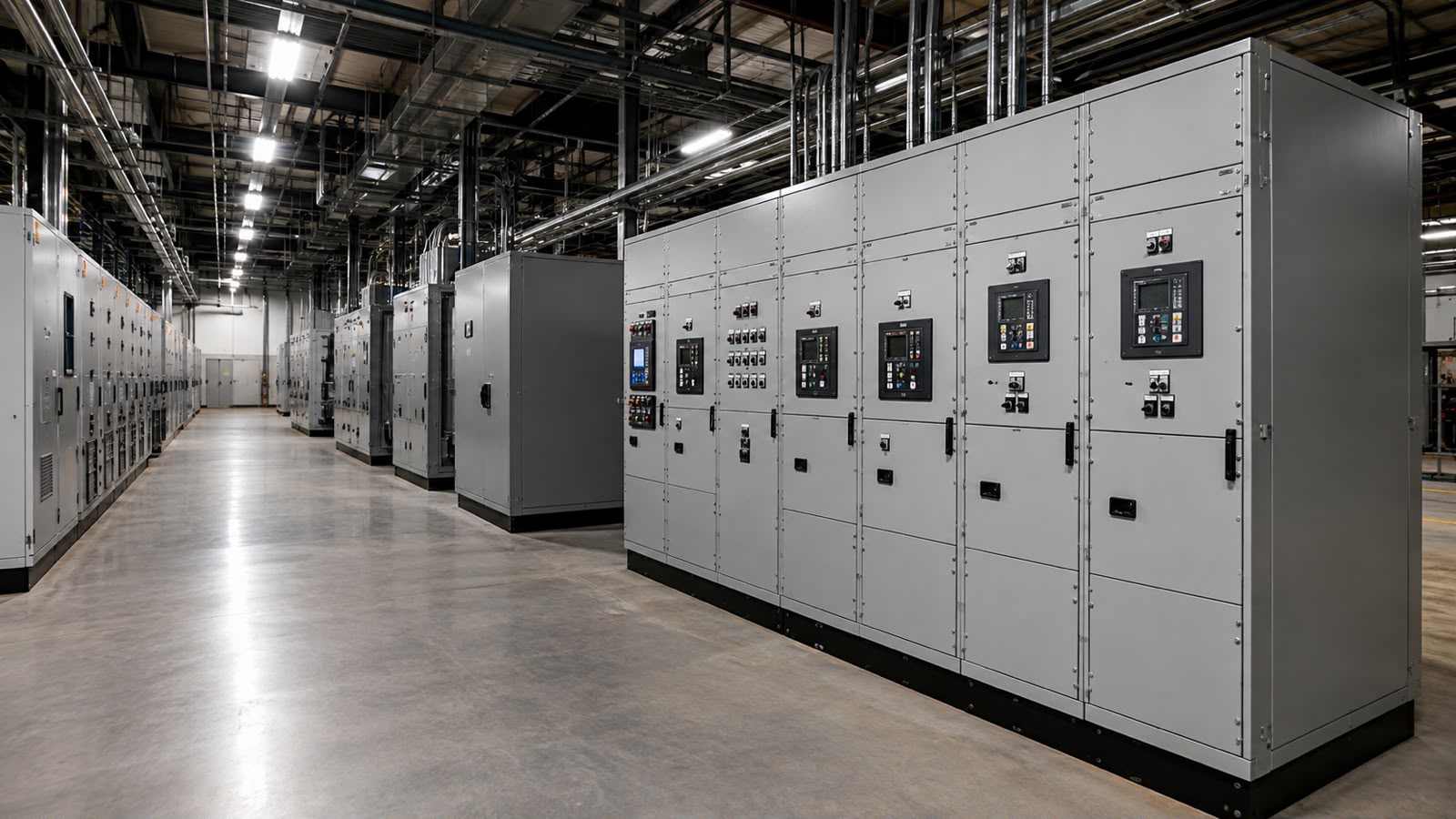
How we specify LV equipment
Categories below are functional, not brand catalogues. Make and model are selected against your measured PF, THD, load variability and solar export — then engineered into a working panel or package.
Active Harmonic Filters
Sample load current continuously and inject the inverse harmonic spectrum, cancelling distortion from the 2nd to about the 50th order in under one cycle. Modules can also supply reactive power and correct imbalance when specified.
Typical ratings: 30 / 60 / 100 / 150 / 200 / 300 A at 415 V; parallel up to site demand; wall or rack; 3-wire and 4-wire.
Where used: VFD-heavy process lines, UPS rooms, rectifier / welder loads, data centres, hospitals, and any PCC that must meet IEEE 519.
SVG / STATCOM
Inverter-based reactive compensation: continuous lead or lag, sub-cycle response, no capacitor steps and no parallel resonance with the supply. Optional harmonic-mitigation mode on many platforms.
Typical ratings: 50–500 kVAr modules at 415 V; parallel to multi-MVAr; indoor IP-rated enclosures.
Where used: Cranes, presses, welders, rolling mills, lifts, solar/wind export sites, and any load that changes faster than a contactor bank can follow.
APFC Panels and Controllers
Switched capacitor steps hold target PF under a controller. We specify contactor or thyristor switching and 2- or 4-quadrant control from load behaviour and whether daytime solar export is present.
Typical ratings: 25–1,000 kVAr at 415 V; 6–16 steps; IP42–IP54; Modbus / RS-485 monitoring.
Where used: C&I consumers billed on PF or kVAh; retrofit of ageing fixed or poorly tuned banks.
Power Capacitors
Three-phase self-healing metallised polypropylene with over-pressure disconnect. Heavy-duty and ultra-heavy-duty grades for elevated harmonic current and ambient temperature.
Typical ratings: 5–100 kVAr/unit at 440 / 480 / 525 V; cylindrical or box; −25 to +55 °C.
Where used: APFC and detuned-filter steps; fixed compensation on motors and transformers.
Detuned and Shunt Reactors
Series reactors move capacitor-step resonance below the dominant harmonic so the bank cannot amplify distortion. Shunt reactors absorb excess kVAr from long cables and lightly loaded transformers.
Typical ratings: 7 % and 14 % detuning; 5–100 kVAr steps; Cu or Al; linear to ~1.8 × In; thermal switch.
Where used: Any capacitor bank feeding drives, UPS or rectifiers — treat as mandatory once THDi is above ~10 %.
Thyristor Switching Modules
Zero-crossing solid-state switches for capacitor steps: no inrush spike, no contact wear, response in a few cycles instead of the 10–20 s delay of contactors.
Typical ratings: 10–100 kVAr per module at 415 V; fan or heatsink cooled; controller-driven.
Where used: Fast-cycling loads, lift/crane feeders, spot-weld lines, frequent step changes.
Line Chokes and Passive Tuned Filters
Drive input chokes cut harmonic emission at source. Tuned LC filters sink a chosen order (typically 5th or 7th) while contributing fundamental kVAr.
Typical ratings: Chokes 3–5 % Z for 1–500 kW drives; tuned filters 50–1,000 kVAr at 4.7th / 6.7th or custom.
Where used: Plants dominated by large, steady 6-pulse drives where an active filter would be oversized for the spectrum.
Need help choosing the right block?
The Power Quality Solution Sizer applies the same selection rules we use on site — PF gap, harmonics, load variability, solar export — and returns an indicative size. Firm ratings follow a measurement.
Technical FAQs
7 % or 14 % detuning?
7 % (~189 Hz) is the default: blocks the 5th and above. Use 14 % (~134 Hz) only when the 3rd is significant — typically large single-phase electronic loads on a 4-wire system.
Expected capacitor life?
Standard duty on a clean network: 8–10 years. Harmonic-rich networks without reactors: often 12–18 months. Heavy-duty cans with detuning and adequate ventilation routinely exceed 10 years.
What is a harmonic-duty capacitor?
A unit rated for continuous current well above nominal (typically 1.5–2.0 × In) and for the higher voltage that appears across a capacitor paired with a detuning reactor — hence 480 V or 525 V ratings on a 415 V system.
Can we retrofit an existing APFC instead of replacing it?
Often. We check enclosure, busbars and protection; fit harmonic-duty capacitors and detuned reactors; upgrade to 4-quadrant control if solar is present; add thyristor switching where cycling is fast. Decision follows a harmonic measurement.
Ready to talk through your site?
Share a few details about your loads and goals. A Syncsine engineer in Chennai replies within one business day — no obligation.