
Top 10 BESS & Power Quality Solutions in Chennai (2026 Guide)
Quick answer: If you’re looking for BESS & Power Quality Solutions in Chennai, the right provider depends on your electricity usage, critical equipment, power-quality problems, solar capacity, and backup requirements. Companies such as Syncsine, Emerich Energy, Balaji Solar, Sahyadri Industries, SEN EDS, EnerCube, Shaktiman, Nantech Power Systems, PS Power Controls, and Waveforms offer different combinations of battery storage, power-quality equipment, solar integration, harmonic filtering, voltage stabilization, and electrical consulting.

What Are BESS & Power Quality Solutions?
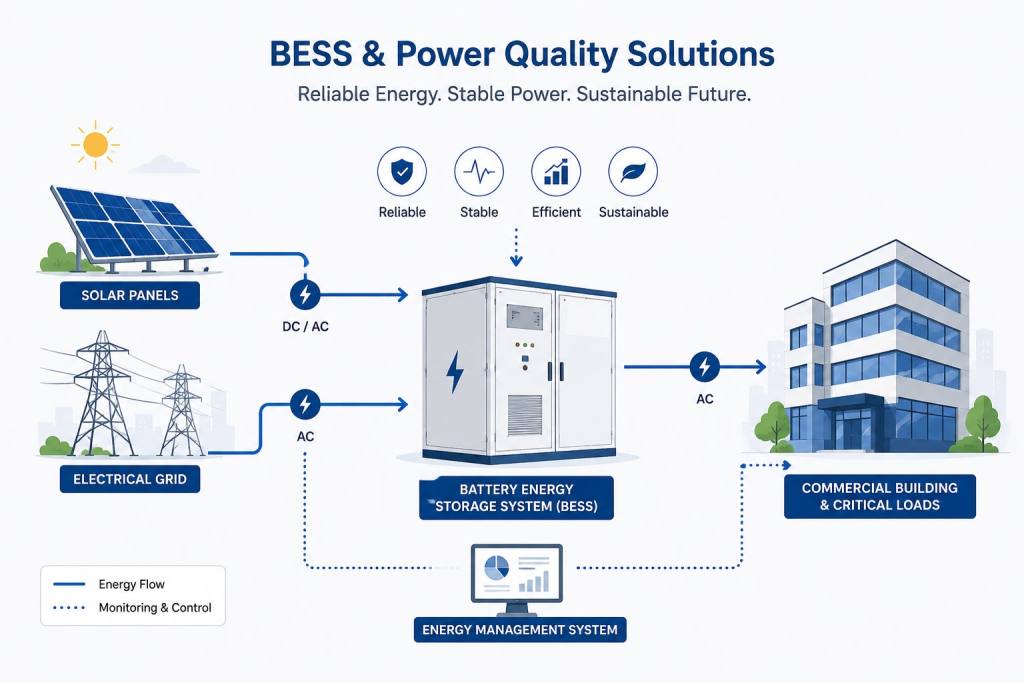
BESS stands for Battery Energy Storage System. It stores electricity in batteries and supplies it when needed.
Power quality is about how stable and reliable the electricity reaching your equipment is. Problems can include voltage fluctuations, harmonics, frequency changes, and interruptions. For a technical primer on these disturbances, IEEE Smart Grid’s power quality resources are a solid reference.
When businesses search for BESS and power quality providers, they’re usually dealing with two connected but different needs: storing electricity, and improving the reliability of the electricity reaching their equipment.
A battery doesn’t automatically fix every power-quality issue, which is why these systems usually combine several technologies. A factory with excessive harmonics may need harmonic filters. A facility with unstable voltage may need a stabilizer. A business facing peak-demand charges may benefit more from storage. That’s why the first step is always understanding the actual electrical problem — explore Syncsine’s power quality and BESS solutions to see how these are typically assessed.
Why Do Businesses Need This?
Electricity is a basic requirement for almost every modern business. A factory needs it to run machines. A hospital needs it for medical equipment. A warehouse may need it for refrigeration and automation. A data center needs stable power for servers and cooling.
Even a short interruption can create problems — a production line stops, a server restarts, a machine trips and needs manual resetting. Poor power quality can cause subtler damage too: equipment overheating, motors underperforming, or components under added stress over time.
This is exactly where these solutions become relevant — combining energy storage with the right power-conditioning technology.
Top 10 Providers in Chennai

The providers below have different strengths — some focus on BESS, others on power-quality equipment or electrical engineering. This is not an official ranking; it’s a comparison guide. Check each provider’s current products, pricing, warranty, certifications, and project experience before deciding.
1. Syncsine
Syncsine focuses on customized energy solutions for commercial and industrial applications, particularly relevant for businesses considering BESS & Power Quality Solutions alongside EV charging infrastructure. Systems are assessed according to load, operating pattern, and energy goals rather than a one-size-fits-all approach.
What Syncsine offers: – Battery energy storage systems – Power-quality solutions – EV charging infrastructure – Site consultation and customized design
Best for: Businesses wanting storage, power quality, and EV charging through one provider. See Syncsine’s EV charging and energy storage offerings for how these are typically combined.
2. Emerich Energy
Emerich Energy manufactures battery storage systems and also works with power-quality products, including active harmonic filters and automatic power-factor correction panels — relevant for businesses that need BESS & Power Quality Solutions covering both storage and electrical conditioning.
Website: https://www.indiamart.com/emerich-energy-private-limited/battery-energy-storage-system.html
3. Balaji Solar
Balaji Solar’s BESS & Power Quality Solutions focus on solar-plus-storage applications. For businesses with existing solar panels, adding storage can shift daytime generation to periods when solar output is lower.
Website: https://balajiraygen.in/bess/
4. Sahyadri Industries
Sahyadri Industries’ BESS & Power Quality Solutions cover residential, commercial, industrial, and utility-scale battery storage applications — a broad range worth researching when different capacity levels are on the table.
Website: https://www.sahyadriindustries.co.in/battery-energy-storage-system-manufacturers-in-chennai.php
5. SEN EDS
SEN EDS’ BESS & Power Quality Solutions combine battery storage with electrical engineering services: power-system engineering, substation design, switchyard design, and electrical studies. Useful for large industrial projects where storage needs to integrate with a wider electrical network.
Website: https://seneds.com/battery-energy-storage-system-in-chennai/
6. EnerCube
EnerCube’s BESS & Power Quality Solutions include storage systems, power conversion systems, and hybrid solar solutions, with a presence across multiple Indian states — useful for multi-location businesses.
Website: https://www.enercube.in/chennai/index.html
7. Shaktiman
Shaktiman’s BESS & Power Quality Solutions include modular battery storage for commercial and industrial use, which suits businesses expecting energy needs to grow over time.
Website: https://shaktiman.co/battery-energy-storage/
8. Nantech Power Systems
Nantech focuses heavily on power-quality equipment — harmonic filters, servo voltage stabilizers, UPS systems, and power-quality audits. Particularly relevant when the real issue turns out to be voltage instability rather than a storage gap.
Website: https://www.nantech.in/power-quality/
9. PS Power Controls
PS Power Controls specializes in testing, harmonic measurement, and electrical audits — valuable because businesses don’t always know what’s actually causing their electrical problems until it’s measured.
Website: https://www.pspowercontrols.com/harmonic-testing-and-solutions.htm
10. Waveforms
Waveforms brings decades of experience in power conditioning, including UPS systems, voltage stabilizers, harmonic filters, and isolation/zig-zag transformers.
Website: http://www.waveforms.co.in/
Quick Comparison
| Company | Main Focus | Best For |
|---|---|---|
| Syncsine | Storage + Power Quality + EV Charging | Combined energy solutions |
| Emerich Energy | Storage + APFC + Harmonic Filtering | Manufacturer-focused buyers |
| Balaji Solar | Storage + Solar | Solar-powered facilities |
| Sahyadri Industries | Storage | Different storage scales |
| SEN EDS | Storage + Electrical Engineering | Large industrial projects |
| EnerCube | Storage + PCS + Solar | Integrated energy projects |
| Shaktiman | Modular Storage | Future expansion |
| Nantech Power Systems | Power Quality | Voltage and harmonic issues |
| PS Power Controls | Power Quality Audits | Electrical diagnosis |
| Waveforms | Power Conditioning | UPS and stabilizer needs |
What Problems Can BESS & Power Quality Solutions Solve?

When evaluating BESS & Power Quality Solutions, voltage fluctuations are a common starting point — can cause flickering lights, tripped machines, or unpredictable equipment behavior. The right fix depends on the cause: a stabilizer, a power-quality filter, or battery storage for critical-load protection.
Another core consideration is handling power interruptions — a BESS can supply stored electricity to selected loads during an outage. Capacity should be sized to the equipment being protected and the required backup time.
These systems also address high peak demand — some businesses draw much more power during certain hours. A battery can discharge during those windows and reduce grid draw — commonly called peak shaving.
A well-designed system accounts for harmonics — produced by VFDs, power converters, LED systems, and other electronic loads. Active harmonic filters are one solution; a battery alone won’t fix this. For a deeper technical breakdown, the Central Electricity Authority’s guidelines on power quality cover Indian regulatory standards.
Finally, storage helps with excess solar generation — a solar system may produce more than a business can use immediately; storage lets you use it later instead of exporting it at a lower rate.
How to Choose the Right BESS & Power Quality Solutions Provider
Start with a power audit. This is the foundation of any good decision here. Measure voltage, current, frequency, power factor, harmonic distortion, and load profile before choosing equipment. Get in touch with our team for a walkthrough of what to request from a vendor before committing.
Identify critical loads. List the equipment that cannot afford to stop — a production line, medical equipment, servers, or refrigeration.
Understand your electricity bill. If most consumption happens during expensive peak periods, storage may have a real cost benefit.
Compare warranty and service beyond just the battery — check coverage for battery cells, BMS, PCS, inverters, installation, replacement parts, and monitoring.
How Much Do BESS & Power Quality Solutions Cost?
There’s no single price — it depends on battery capacity, power rating, chemistry, PCS, energy management software, solar integration, harmonic filters, stabilizers, installation, and monitoring. A small commercial project and a large manufacturing facility will have very different costs. The best approach is a detailed quotation after a site assessment.
Are BESS & Power Quality Solutions Worth It?
Whether this kind of investment is worth it depends on the problem. If a factory loses several hours of production monthly to electrical interruptions, the financial loss — lost output, downtime, wasted materials, restart costs, delayed orders, equipment damage — can justify the investment. If interruptions are rare, a large battery may not be necessary; sometimes a simpler power-quality fix solves it. Start with measurement, not assumptions.
BESS & Power Quality Solutions By Facility Type
Manufacturing — these systems are especially valuable here since motors, compressors, VFDs, and automated controls create complex electrical conditions where voltage disturbances stop production, harmonics stress equipment, and solar generation may not match production hours.
Hospitals — storage and power quality equipment play a critical role since there’s near-zero tolerance for interruptions. Battery storage typically works alongside generators and UPS systems, providing fast response while other backup systems handle longer outages.
Data centers — the role here extends well beyond backup power since these facilities need round-the-clock stability. A typical strategy combines UPS, generators, storage, power-quality equipment, and monitoring — the role here extends beyond backup into power continuity and peak-demand control.
Warehouses — these solutions are increasingly relevant as facilities become increasingly electricity-intensive with automated storage, conveyors, robotics, and EV chargers. For facilities adding EV charging, storage is often part of a broader energy-management plan.
Deciding What BESS & Power Quality Solutions You Actually Need
- Do I need backup power? → Identify which equipment must stay online.
- Do I have voltage problems? → Run a power-quality assessment.
- Do I have harmonic problems? → Investigate measurement and filtering.
- Do I have solar? → Check whether excess generation can be stored.
- Do I have high peak demand? → Calculate potential savings from peak shaving.
- Am I adding EV chargers? → Calculate additional load and grid capacity.
Questions to Ask a BESS & Power Quality Solutions Provider
- What size system do I actually need, and how was that calculated?
- What battery chemistry are you using, and what’s the expected cycle life?
- What does the warranty cover?
- Can the system work with solar and my generator?
- Can it support EV charging?
- What monitoring and maintenance are included?
- How quickly can you provide service?
- What happens at end of battery life?
- Can you provide references for similar projects?
Signs You Should Investigate BESS & Power Quality Solutions
- Equipment frequently trips
- Production stops unexpectedly
- Electricity costs rise during peak hours
- You have a large solar installation
- You’re adding EV charging
- Your facility has sensitive electronic equipment
- Your generator responds too slowly
- You need longer backup than a standard UPS provides
- You suspect harmonic problems or repeated voltage disturbances
Having one of these signs doesn’t automatically mean you need a battery — it means the system is worth assessing.
Frequently Asked Questions
What does BESS stand for? Battery Energy Storage System — it stores electrical energy and supplies it when required.
What does BESS & Power Quality Solutions mean? It refers to battery storage combined with technologies used to improve the reliability and quality of electricity reaching equipment.
Which company is best in Chennai? No single provider suits every project — it depends on load, storage requirement, power-quality problem, solar capacity, budget, and project size.
How much do BESS & Power Quality Solutions cost? No fixed price; depends on capacity, power rating, chemistry, PCS, installation, safety equipment, and monitoring.
Can BESS & Power Quality Solutions reduce electricity bills? In certain applications, yes — for example, reducing peak demand or storing solar energy for later use.
Can BESS & Power Quality Solutions work with solar? Yes — a BESS can store surplus solar electricity for later use.
Is BESS better than a diesel generator? Not necessarily. Batteries respond faster; generators provide longer-duration backup when fuel is available. Many facilities use both.
Can BESS fix harmonics? Not automatically — harmonic problems typically need active harmonic filters or other dedicated power-quality equipment.
What is a power-quality audit? A measurement of voltage, current, frequency, power factor, and harmonic distortion, used to identify problems before equipment is selected.
Final Thoughts
Choosing the right setup isn’t about buying the biggest battery or the cheapest quote — it’s about understanding how electricity is used in your facility and what’s actually causing your current problems. A factory may need storage and harmonic filtering. A commercial building may benefit from solar storage and peak-demand management. A hospital may need storage alongside UPS and generators. A warehouse may want storage to support solar and EV charging.
Start with an assessment before committing to any storage or power-quality package. Measure the electrical system. Identify critical loads. Understand your electricity costs. Then compare providers based on the solution they can actually deliver.
If you’re researching BESS & Power Quality Solutions in Chennai, you can contact Syncsine for a free site consultation, learn more about our team, or browse our blog for more guides like this one.
FAQs
Is BESS safe to install?
Yes, when installed and maintained properly. Modern battery energy storage systems include multiple safety layers cell-level monitoring, thermal management, off-gas detection, and fire suppression systems. Always confirm certifications and safety compliance with your provider before installation.
How long do BESS batteries typically last?
Most commercial systems using LFP (Lithium Iron Phosphate) batteries are warrantied for around 10 years and designed to operate for 15–20 years, delivering roughly 6,000–8,000 charge cycles depending on usage and operating conditions. Ask your provider for the specific chemistry and cycle-life numbers for your system.
Are there government subsidies for BESS in India?
It depends on the setup. A standalone battery storage system currently doesn’t qualify for the PM Surya Ghar subsidy, but a combined solar-plus-storage system can still receive the solar portion of the subsidy. Check with your provider or local electricity board for the latest state-level BESS incentives, since these vary and are updated periodically.
What’s the difference between BESS and a regular UPS?
A UPS typically provides short-duration backup power to protect critical equipment during brief outages. A BESS is designed for larger-scale energy storage, longer backup duration, and additional uses such as peak shaving and storing excess solar generation.
Does BESS lose efficiency or capacity over time?
Yes, to some extent. Round-trip efficiency losses (energy lost converting power in and out of the battery) typically run about 10–15%. Battery capacity also degrades gradually, often dropping to around 70–80% of its original capacity by year 10, depending on the battery chemistry and how the system is used. This is why checking cycle life and degradation warranties with your provider matters.